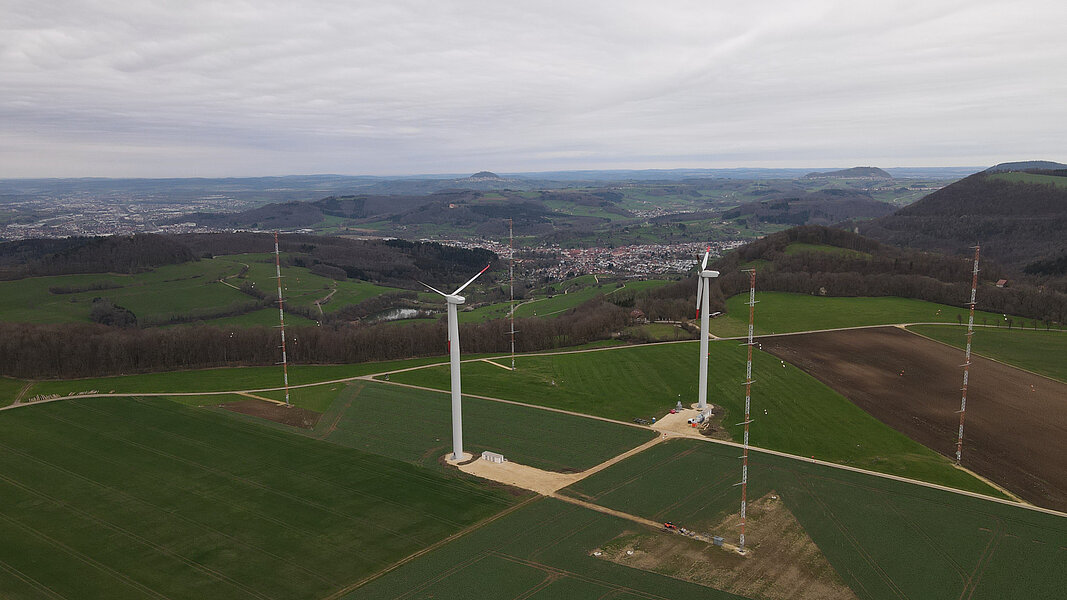
“NatForWINSENT-II” thus makes an important contribution to the research and development of technical systems for wind turbines, with the aim of preventing conflicts with species sensitive to wind energy.
To mark the start of the nature conservation research, Dr Alfred Herberg, Head of the ‘Protection, Development and Sustainable Use of Nature and the Landscape’ division at the Federal Agency for Nature Conservation (BfN), and Prof. Dr Frithjof Staiß, Executive Director of the Centre for Solar Energy and Hydrogen Research Baden-Württemberg (ZSW), visited the site on 22 April to see the facility for themselves.
“I am delighted that the ZSW, as the operator, has made it possible to use the wind energy test site to investigate nature conservation issues as well,” said Dr Alfred Herberg. “The NatForWINSENT project has the potential to yield crucial insights into which effective measures can be taken to further improve the coexistence of wind energy use and species conservation.”
Frithjof Staiß also emphasised the importance of nature conservation research: “Our research at the test site is intended to advance the use of wind energy. Whilst our focus is particularly on optimising wind turbines, we are also aware of the importance of supporting measures beyond the technology used to generate electricity. That is why research into nature conservation issues is of particular importance to us.”
With funding from the Federal Ministry for the Environment (BMUV), as part of the funding framework for national species conservation programmes, the BfN is providing just under 1.45 million euros to support the current phase of the “NatForWINSENT-II: Implementing nature conservation research at the onshore wind test site” project. The project, led by the ZSW, is being carried out by a team of researchers from internationally renowned institutions.
On site, they have the opportunity for the first time to intervene in the control systems of the wind turbines for the purposes of their research and, for example, to study the behaviour of birds at different rotor speeds. Another distinctive feature of the test site is its comprehensive technical infrastructure. The data recorded by a wide range of state-of-the-art measuring instruments enables the best possible insights to be gained through the analysis of both the biotic measurements themselves (e.g. radar, telemetry, laser rangefinders) and the targeted integration of these ecological data with abiotic measurement data (visibility, turbulence and other meteorological parameters). From this, conclusions can be drawn, for example, as to the weather conditions under which birds and bats are at greater risk and those under which they are at less risk. On this basis, mitigation measures are to be devised that ensure the greatest possible protection whilst optimising energy generation.