The analyses have shown that, in order to reduce forecast uncertainty, sampling at nacelle level on as many wind turbines as possible within a wind farm is usually more efficient than carrying out additional tower-level measurements.
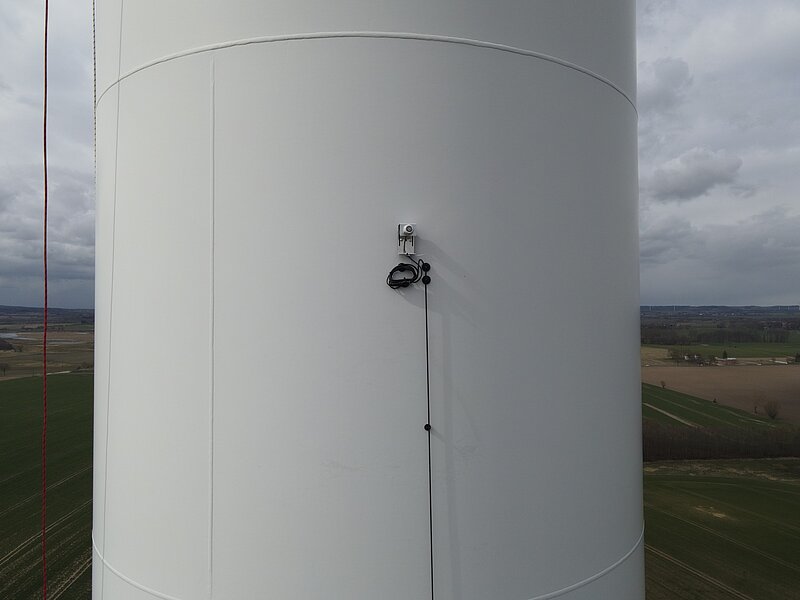
From a technical point of view, it makes sense to install an additional tower microphone on wind turbines with a small rotor-free zone. An additional monitoring point on the tower is recommended for wind turbines with a rotor-free zone of less than 30 m, as well as for those with a rotor-free zone of less than 60 m, if there are large roosts of bat species at risk of collision nearby or if land use suggests a high level of bat activity. Monitoring standards are defined for the use of a tower microphone.
In addition, a separate project was carried out to test the reliability of measurements from rainfall sensors. The results showed that two high-quality measuring devices were able to provide plausible data.
Oliver Behr, Sören Greule, Johanna Grimm, Christof Happ, Fränzi Korner-Nievergelt und Florian Stehr. Die Höhenverteilung von Fledermäusen an Windenergieanlagen. BfN-Schriften 741. Bonn 2025