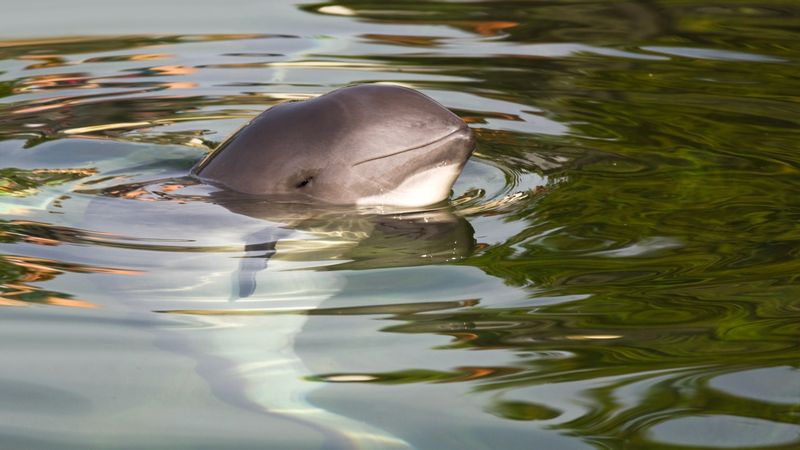
The Baltic Sea is experiencing an increase in pile driving for wind power exploitation that also affects areas used by harbour porpoises. In view of this and due to the current threat to a potential population of the harbour porpoise in the inner Baltic Sea, it is essential to know the seasonal distribution of this population of harbour porpoises and to separate this population from individuals belonging to other populations.
The aim of the project is to categorise the population genome of a representative data set of individual Baltic Sea harbour porpoises in order to
- check the existence of a separate harbour porpoise population in the inner Baltic Sea,
- determine the distribution of this population regionally and seasonally and
- separate individuals of this population from migratory individuals of other populations.
Methods
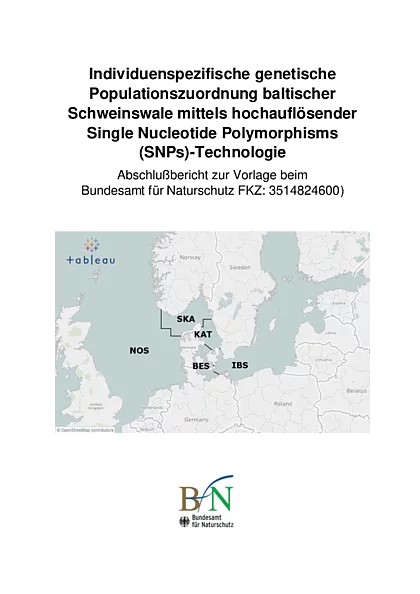
Using RAD-tag genotyping by sequencing, SNPs will be examined in several hundred individuals (approx. 100 from each of the inner Baltic Sea, Beltsee/Kattegat and North Sea/Skagerak). Samples from the breeding season will mainly be used if possible. Additional individuals will be used for comparison with external groups (Iceland, Spain) and to enhance the Baltic Sea data set (e.g. including other samples from outside the breeding season to identify migrating individuals).
Results
- Establishing genomic resources for the harbour porpoise
- Describing the harbour porpoise populations in the Baltic Sea/Skagerak/North Sea region
- Determining the geographical and seasonal distribution of the populations
- Describing seasonal migration and genetic exchange between populations
- Assessing genetic variability of the Baltic Sea population of the harbour porpoise
Project management
University of Potsdam
Institute of Biochemistry und Biology
Prof. Dr. Ralph Tiedemann
Tel.: +49 331 977-5249
tiedeman@uni-potsdam.de
Topics
Offshore wind energyKeywords
Biodiversity Marine Species Wind Power Offshore Wind Power Federal Nature Conservation Act Conservation Areas Environmental Impact Assessment / Strategic Environmental Assessment International National Policy Recommendations Federal Agency for Nature Conservation (BfN) Federal Ministry for the Environment, Nature Conservation Completed Results publishedRelated News
Related Projects
FKZ 3515822000 FKZ3515822000 Underwater noise effects from offshore wind energy (UWE)
With the use of the North and Baltic Seas as sites for wind turbines, marine mammals are being exposed to increasing underwater noise. The planned methods and measuring procedures enable an evaluation…

FKZ 3515822100 FKZ3515822100 BIRDMOVE – Bird migration and offshore wind
The aim of the project is to study the potential effects of offshore wind turbines on migratory birds and passage migrants.
