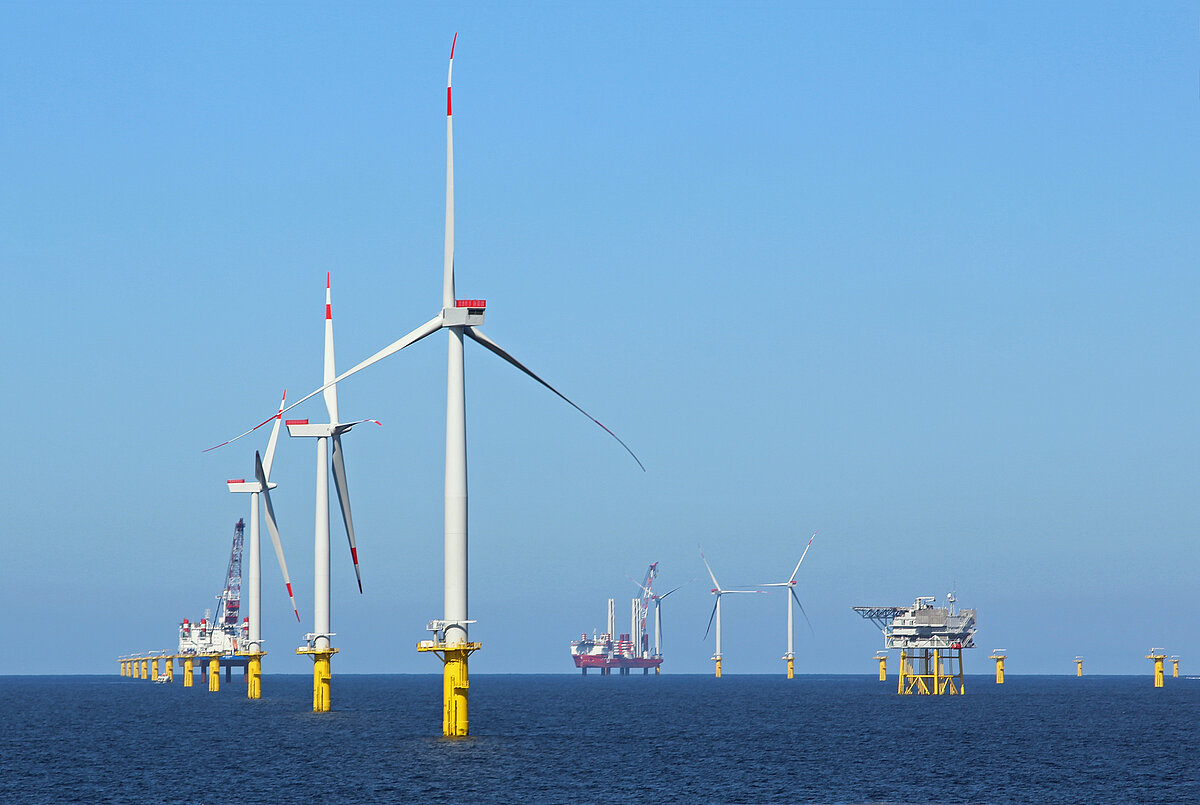
The decommissioning of offshore wind farms, submarine cables and other marine infrastructure poses new challenges for marine nature conservation. The project examines technical decommissioning options and their ecological impacts, assesses possible effects on species and habitats, and develops a practical decision-support tool. The aim is to help authorities and project developers plan offshore decommissioning on a sound technical basis in a way that is compatible with nature.
Research Question / Project Objectives
As offshore wind farms and other marine infrastructure increasingly reach the end of their service life, decommissioning is becoming ever more important. This raises the question of how different decommissioning options can be implemented technically and what effects they have on the marine environment. Depending on the method used, the impacts on the seabed, flora and fauna can vary.
The project sits at the interface between technical feasibility and nature conservation. It creates a factual basis for making decommissioning options comparable, for adequately considering ecological impacts, and for identifying existing knowledge gaps. The decision-support compendium developed on this basis is intended to help authorities and project developers plan future decommissioning projects on a well-founded basis.
The goal is to create a transparent technical basis for the decommissioning of offshore installations and to integrate the protection of marine nature into the planning process at an early stage.
Approach / Method
How can the decommissioning of offshore infrastructure be implemented technically while also being compatible with nature? To answer this question, the project combines technical expertise with nature-conservation assessment and uses this to develop a practical decision-making basis.
The starting point is a systematic review of existing decommissioning methods and international experience. Their technical possibilities, practical framework conditions and limits are analysed and prepared for comparison. Building on this, the potential impacts on marine nature are examined and evaluated against relevant ecological and legal criteria.
The findings are then brought together so that the different decommissioning options can be compared in a transparent way. Existing knowledge gaps and further research needs are also made visible.
In this way, a practical decision-support compendium is developed step by step. It links technical options with nature-conservation requirements and supports authorities and project developers in planning future decommissioning projects.
The project is structured into three successive work packages.
WP1: Technical decommissioning options
The first work package examines technical and practical decommissioning options for foundations, submarine cables and scour protection. It considers full and partial removal as well as leaving infrastructure components in place, with regard to their technical requirements, limits and logistical demands. Method profiles, assessment matrices, a SWOT analysis and international experience form the basis for comparing the procedures.
WP2: Impacts on marine nature
The second work package looks at the ecological impacts of the decommissioning methods. The focus is on relevant impact factors and affected protected features, including marine mammals, seabirds and migratory birds, fish, benthos, biotopes and protected habitats. Nature-conservation law requirements and options for avoiding and mitigating impacts are taken into account. The work package also identifies existing knowledge gaps and further research needs.
WP3: Development of a decision-support compendium
The third work package brings the results of the previous work packages together in a practical decision-support compendium for authorities and project developers. It links decommissioning options with site conditions and ecological assessment criteria and supports their expert classification.
Project management
ARSU GmbH
Kreyenstr. 41, 26127 Oldenburg
Kerstin Bernhardt
bernhardt@arsu.de
Fon.: +49 441 683030-11
Project partner
KONGSTEIN GmbH
Tim Müller
tm@kongstein.com
Fon.: +49 162 6368764
Funding authority
Federal Agency for Nature Conservation (BfN)
Alte Messe 6, 04103 Leipzig
FG II 4.4 Permit Procedures in the EEZ
FG-II44@BfN.de
Fon.: +49 341 309770
Topics
Offshore wind energyKeywords
Birds Air Wind Power Offshore Wind Power Federal Nature Conservation Act Landscape Planning International National Regional Local Field Studies Case Studies Policy Recommendations Method Development Conventions Standards Expansion of Impact Knowledge Federal Agency for Nature Conservation (BfN) Federal Ministry for the Environment, Nature Conservation CompletedRelated News
Related Projects
FKZ 3520860100 FKZ3520860100 Offshore wind farms and seabirds II
The project analyses the effects of offshore wind farms (OWF) on seabirds in the North and Baltic Seas. A particular focus here is on analysing the cumulative effects of the numerous wind farms…

FKZ 3520860100 FKZ3520860100 Offshore wind farms and seabirds
The project "Expansion of offshore wind energy in Germany: Effects on seabirds in the North and Baltic Seas" (OWP Seabirds) aims to investigate in more detail how offshore wind farms in operation…

FKZ 3523151601 FKZ3523151601 Bird protection at offshore wind turbines
The threat to bird migration represents a potential conflict for the expansion of offshore wind energy. However, there is currently no technical basis for recognising periods of increased collision…
FKZ 352315100B FKZ352315100B Songbird migration offshore
Every year, millions of songbirds fly over the North Sea as they migrate between their wintering and breeding grounds. However, this behaviour is still poorly understood with regard to the massive…
FKZ 3519861400 FKZ3519861400 TRACKBIRD - Bird migration over the North Sea and Baltic Sea and offshore wind energy
The aim of the project is to study the potential effects of offshore wind turbines on migratory birds and passage migrants.
FKZ 3515822100 FKZ3515822100 BIRDMOVE – Bird migration and offshore wind
The aim of the project is to study the potential effects of offshore wind turbines on migratory birds and passage migrants.

MarinEARS
The BSH's MarinEARS technical information system collects data on pile driving noise during the erection of foundations for offshore wind turbines. It is a scientifically and organisationally…