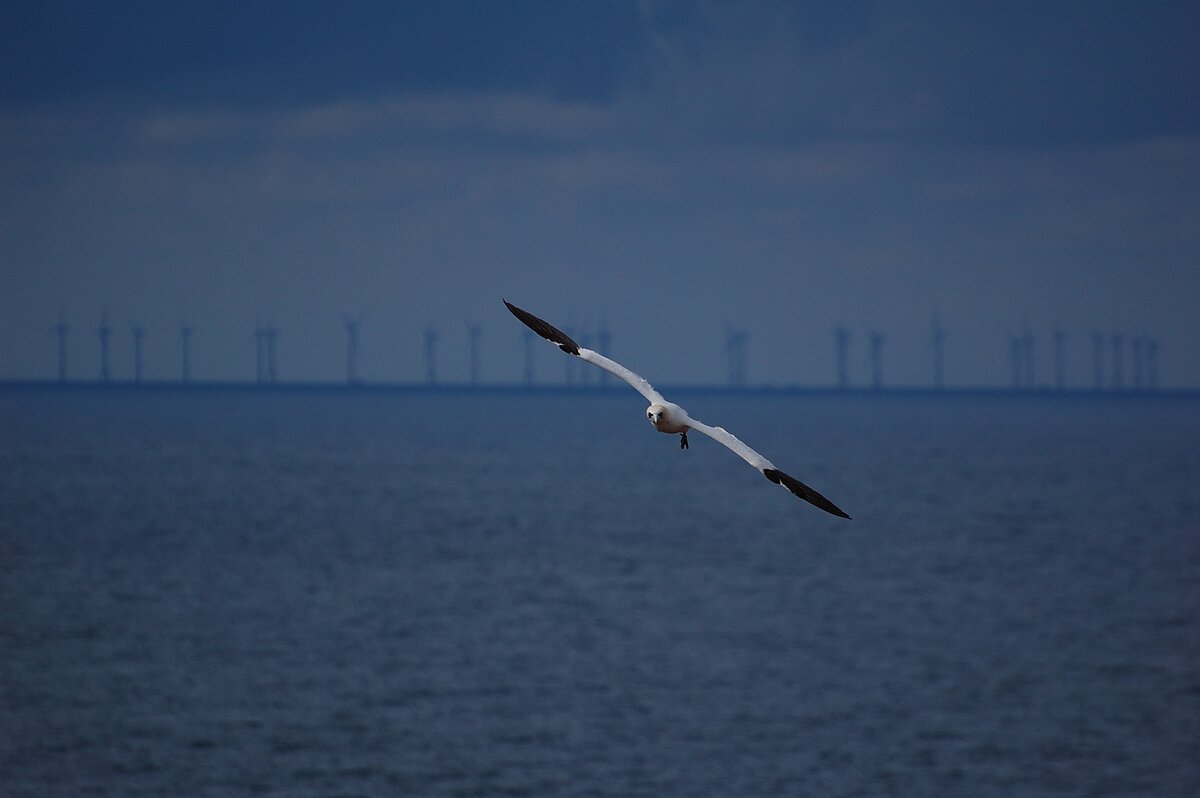
The project analyses the effects of offshore wind farms (OWF) on seabirds in the North and Baltic Seas. A particular focus here is on analysing the cumulative effects of the numerous wind farms already in operation and assessing the consequences of further large-scale planned wind farms on seabirds. The findings will be used to design possible avoidance and mitigation measures.
Research Question / Project Objectives
At least 70 gigawatts (GW) of offshore wind energy are to be installed in the German Exclusive Economic Zone (EEZ) by 2045. The areas designated for this correspond to just under a fifth of the German EEZ in the North Sea. As the areas planned to date will not be sufficient for the installation of 70 GW, the aim is to designate further areas for the construction of offshore wind farms (OWP). This results in a large spatial overlap with areas that serve seabirds as feeding or resting areas, among other things.
OWPs can have various impacts on seabirds. These include habitat loss, barrier or attraction effects and an increased risk of collision mortality. Some important findings on the effects of OWPs on seabirds have already been gathered in recent years through several research projects.
The aim of the current project is to analyse the cumulative effects of the numerous wind farms currently in operation in the North Sea and Baltic Sea on seabirds. In addition, the possible effects of further large-scale planned wind farms on seabirds are to be assessed. In addition, it will be analysed whether seabirds can possibly become accustomed to the presence of offshore wind farms in their natural habitat over longer periods of time. The knowledge gained will be used to design effective avoidance and mitigation measures for the protection of seabirds and thus counteract the negative effects of OWPs.
Approach / Method
The cumulative effects of wind farms in operation in the North Sea and Baltic Sea on seabirds will first be analysed with the help of statistical modelling, which has already been developed in the previous project (OWP seabirds) and applied to common guillemots. The analysis is based on the available data sets from the years 2000-2024 on the occurrence of seabirds in German waters (from research projects, marine biodiversity monitoring and environmental monitoring carried out at offshore wind farms). The aim is then to predict how different OWP expansion scenarios in the North Sea and Baltic Sea would affect the distribution and abundance of different seabird species. In order to understand whether the reactions of seabirds to OWPs change over time, methods will be developed to analyse potential habituation effects. Based on the findings, a concept for possible avoidance and mitigation measures for OWP impacts on seabirds will be developed and existing measures will be evaluated based on available data. In view of the OWP plans in neighbouring countries, a concept for an international analysis will also be drawn up and a corresponding feasibility study carried out.
Project management
Dachverband Deutscher Avifaunisten (DDA) e.V.
c/o Research and Technology Centre, West Coast (FTZ)
Hafentoern 1
D-25761 Büsum
Dr Verena Peschko
Peschko@dda-web.de
Project partners
Bionum GmbH
An den Speichern 4, D-48157 Muenster
info@bionum.de
Funding authority
Federal Agency for Nature Conservation (BfN)
Vilm Office
Department II 3.3: Human impact, ecological issues in marine projects
D-18581 Putbus/Rügen
Dr Stefanie Großer
Stefanie.Grosser@BfN.de
- Continuous project coordination
- Preparation of visual and digital survey data from various data sources
- Analysis of the distribution and abundance of seabirds in the German North Sea and Baltic Sea in relation to offshore wind farms
- Forecast of distribution and abundance changes of selected seabird species for different OWP expansion scenarios Method development and analysis of possible habituation effects of seabirds in relation to offshore wind farms expansion scenarios
- Method development and analysis of possible habituation effects of seabirds in relation to offshore wind farms
- Development of a concept for avoidance and mitigation measures for OWP effects on seabirds in the German North Sea and Baltic Sea
- International analysis of cumulative effects of OWPs on various seabird species - concept development and feasibility study
Topics
Offshore wind energyKeywords
Birds Air Wind Power Offshore Wind Power Federal Nature Conservation Act Landscape Planning International National Regional Local Field Studies Case Studies Policy Recommendations Method Development Conventions Standards Expansion of Impact Knowledge Federal Agency for Nature Conservation (BfN) Federal Ministry for the Environment, Nature Conservation CompletedRelated News
(Kopie 8)
Monitoring reports and field surveys sought for an ongoing expert assessment of birds, bats, sand lizards and field hamsters

November 7, 2024, 10:00 a.m.–4:00 p.m., Tagungszentrum im Haus der Bundespressekonferenz, Berlin

6 November 2024, 3.00–5.30 pm, Conference Centre at the Federal Press Conference Building, Berlin & online via livestream

Related Projects
FKZ 3520860100 FKZ3520860100 Offshore wind farms and seabirds
The project "Expansion of offshore wind energy in Germany: Effects on seabirds in the North and Baltic Seas" (OWP Seabirds) aims to investigate in more detail how offshore wind farms in operation…
![[Translate to English:]](/fileadmin/_processed_/3/4/csm_iStock-1270075069_8f2fc3691a.jpg "[Translate to English:]")
FKZ 3523151601 FKZ3523151601 Bird protection at offshore wind turbines
The threat to bird migration represents a potential conflict for the expansion of offshore wind energy. However, there is currently no technical basis for recognising periods of increased collision…
![[Translate to English:]](/fileadmin/_processed_/8/5/csm_Gauger_Kai_Windkraft_12_ea60b77e66.jpg "[Translate to English:]")
FKZ 352315100B FKZ352315100B Songbird migration offshore
Every year, millions of songbirds fly over the North Sea as they migrate between their wintering and breeding grounds. However, this behaviour is still poorly understood with regard to the massive…
![[Translate to English:]](/fileadmin/_processed_/3/8/csm_Singvogelzug_Offshore_Montage_01f737fcca.jpg "[Translate to English:]")
FKZ 3519861400 FKZ3519861400 TRACKBIRD - Bird migration over the North Sea and Baltic Sea and offshore wind energy
The aim of the project is to study the potential effects of offshore wind turbines on migratory birds and passage migrants.
![[Translate to English:]](/fileadmin/_processed_/1/4/csm_TRACKBIRD-Radiotelemetrie-Empfangsstation_9375aa8919.jpg "[Translate to English:]")
FKZ 3515822100 FKZ3515822100 BIRDMOVE – Bird migration and offshore wind
The aim of the project is to study the potential effects of offshore wind turbines on migratory birds and passage migrants.

FKZ 3519861300 FKZ3519861300 Batmobile - Impact of offshore wind farms on bats in the German Bight and the Baltic
As part of the expansion of renewable energies in Germany, the further expansion of offshore wind energy is also planned. Consequently, there is an increasing risk of collision and thus mortality for…
![[Translate to English:]](/fileadmin/_processed_/b/8/csm_Batmobil_NyctalusNoctula-AntjeSeebens-Hoyer_teas_fb72aef5b9.png "[Translate to English:]")