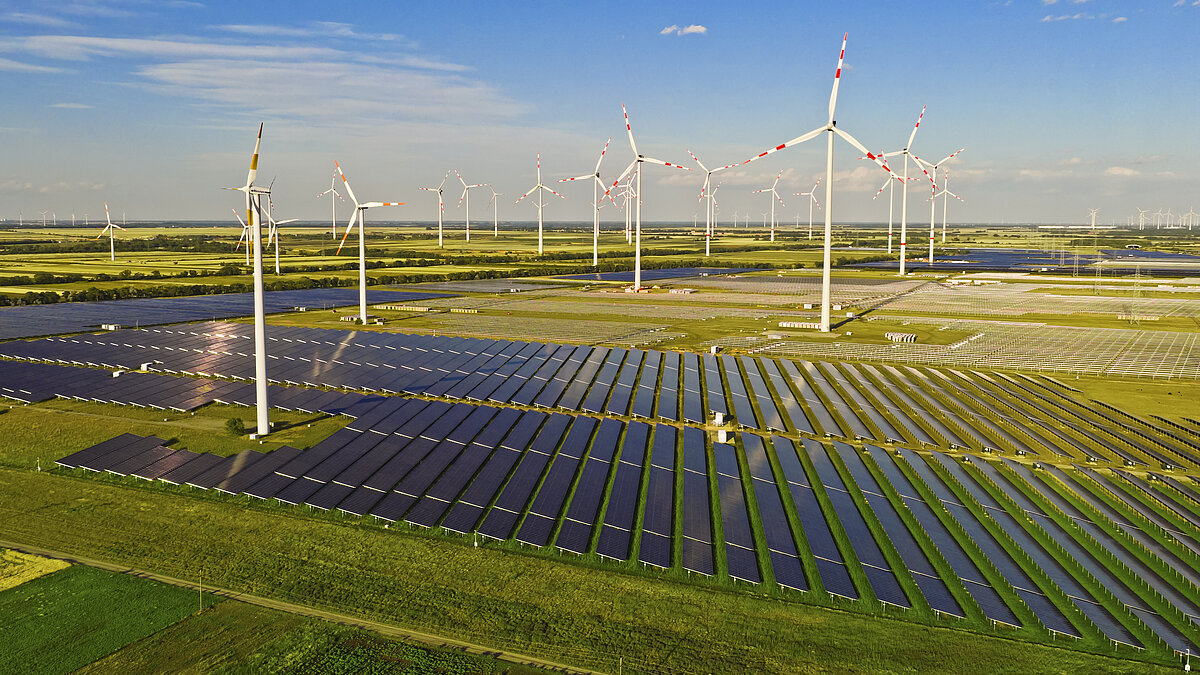
The aim of the project is to develop professionally derived proposals for standardization in the expansion of photovoltaics, in the areas of impact mitigation rules (Eingriffsregelung), use of mown green material, end of operating life and dismantling, and effects of hybrid projects (wind-PV). These proposals are intended to form the basis for federal statutory and subordinate regulatory needs for safeguarding nature conservation concerns while pursuing acceleration and simplification of solar energy and hybrid projects.
Research question / project objectives
The project aims to develop professionally derived proposals for standardizations and simplifications that make it easier to apply impact mitigation rules (Eingriffsregelung) and species protection law to PV projects, without lowering the level of nature conservation protection.
The background is the rapid growth of ground-mounted PV installations (PV-FFA) and agrivoltaics. Impact mitigation rules are applied differently depending on the federal state, the approval procedure and the type of installation. This leads to legal uncertainty, unequal compensation requirements and high review effort. At the same time, new questions are coming to the fore: the use of mown material from area maintenance, the handling of ecologically upgraded areas during repowering and dismantling, and the cumulative effects of combined wind-PV sites.
The project covers the entire life cycle of the installation: impact mitigation rules during construction, use of green waste and maintenance material, end of operating life with repowering and dismantling, and the specific effects of hybrid wind and PV projects.
The results are intended to form the basis for federal statutory and subordinate regulatory needs for clarification.
Approach
The project combines detailed nature conservation expertise, legal classification and practical understanding of permitting. Methodologically, it relies on structured document and literature analysis and a systematic state-by-state and procedure screening based on uniform review and assessment matrices.
Typical case constellations are used to work through standardization options in concrete terms. The developed proposals are tested against a uniform assessment framework covering protective effect, practicability of enforcement, effort and legal compatibility, and are mirrored against the European and national legal framework.
Expert interviews, a specialist workshop and a project-accompanying working group with stakeholders from administration, practice, science and associations ensure practical applicability.
The outcome should be robust, enforceable standardization elements that accelerate review and approval procedures, increase the traceability of review decisions and, at the same time, safeguard the level of nature conservation protection.
- Work package 2.1 – Photovoltaik: Comparative screening of state-level practice on nature conservation and planning law impact mitigation rules (Eingriffsregelung) for ground-mounted PV installations (PV-FFA) and agrivoltaics; overview of review, assessment and compensation logics, including the question of when on-site compensation is technically sound and when external compensation remains necessary; derivation and legal review of standardization proposals, taking species protection law into account.
- Work package 2.2 – Photovoltaics and green waste utilization: Analysis of agricultural, waste and feed law obstacles to marketing mown material from PV-FFA as an agricultural product; assessment of practical utilization pathways and quality requirements (e.g., roughage, biogas, composting); development of legal options for action.
- Work package 2.3 – End of operating life and dismantling: Structuring of case groups, review of impact mitigation rules during repowering, assessment of dismantling effects and subsequent use of ecologically upgraded areas, and legal classification of the options for action.
- Work package 2.4 – Effects of wind-PV hybrid projects: Delineation of typical hybrid constellations and impact pathways, structured literature analysis, impact matrix by protected asset with transparent identification of knowledge gaps, and initial technical requirements for installation configuration, protective measures and maintenance concepts.
- Work package 2.5 – Ad hoc advisory: Short-notice technical and legal advice to the BfN (Federal Agency for Nature Conservation) on detailed and legal questions throughout the project term.
Projectmanagement
Arepo GmbH
Albrechtstr. 22
10117 Berlin
Dr Guido Ropers
Tel.: 0049 30 220 124 48
ropers@arepo-consult.com
Projektpartner
GLU GmbH Jena
Saalbahnhofstr. 27
07743 Jena
Olaf Müller
Tel.: 0049 3641-4628-0
olaf.mueller@glu.de
IKEM – Institut für Klimaschutz, Energie und Mobilität e.V.
Alte Jakobstr. 85-86
10179 Berlin
Dr Michael Kalis
Tel.: 0049 30 408 18 70-25
michael.kalis@ikem.de
Funding
Bundesamt für Naturschutz (BfN)
Standort Leipzig
Alte Messe 6
04013 Leipzig
Jens Ponitka
Tel: 0049 341 30977-169
jens.ponitka@bfn.de
Topics
Innovative solar energy installations Land use and energy landscapes Nature conservation in planning and permitting procedures Solar energy and biodiversityKeywords
Biodiversity Landscape Protected Areas Water Biotopes Solar Power Federal Nature Conservation Act Federal Water Act Impact Mitigation Regulation Landscape Planning Environmental Impact Assessment / Strategic Environmental Assessment Renewable Energy Sources Act Regional Planning Urban land-use Planning Species Protection Biotope Protection National Regional Local Case Studies Synopsis Literature Reviews and Analysis Policy Recommendations Expert Recommendations Federal Agency for Nature Conservation (BfN) Federal Ministry for the Environment, Nature Conservation OngoingRelated Projects
FKZ 3520861400 FKZ3520861400 Agrivoltaics and nature conservation
Agrivoltaics – ground-mounted photovoltaics – play a key role in the expansion of renewable energies. In addition to the prevailing low-mounted solar farms, whose acreages are withdrawn from…
![[Translate to English:]](/fileadmin/_processed_/3/e/csm_Ernte_Agrophotovoltaikanlage_teaser_c_Max_Trommsdorff_Own_work_CC_BY-SA_4_0_86830cef22.jpg "[Translate to English:]")
Biodiversity in solar farms
Innovative concepts and establishment of demonstrators to improve reconciliation of photovoltaic systems, nature conservation and agriculture (BIODIV-SOLAR)